From Rubble to Roots: Six Stories of Survival and Resilience
Every family has roots. But some lie buried deep beneath rubble, under the weight of war, loss, and silence.
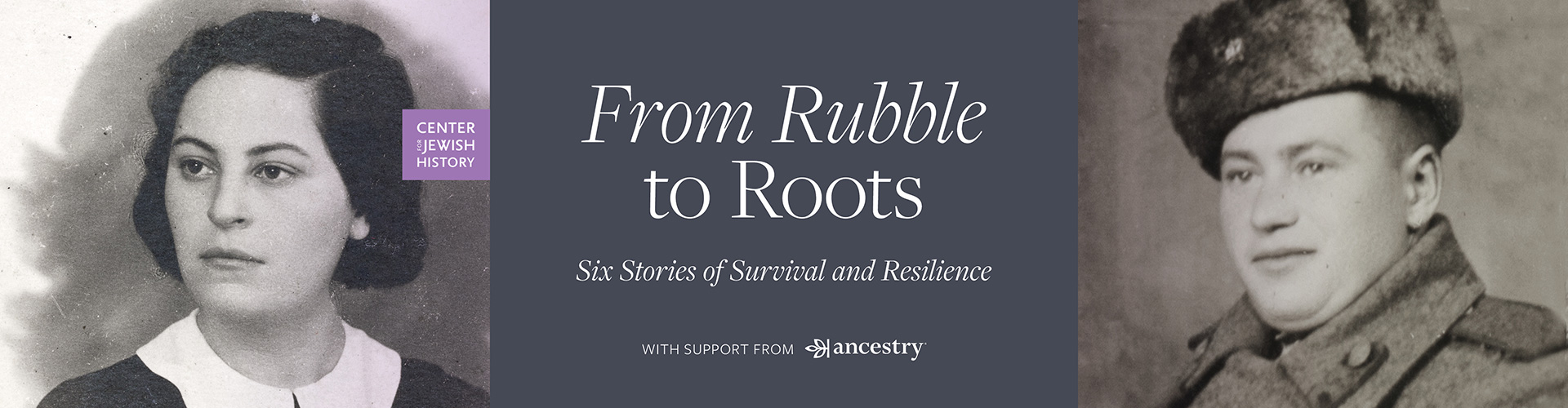
Photographs, documents, and personal objects belonging to Holocaust survivors are among the more fragile forms of historical evidence, vulnerable to destruction and displacement. This exhibition brings together such materials from six families, many presented to the public for the first time.
From Rubble to Roots originated as a podcast series produced by the Center for Jewish History with support from Ancestry®, dedicated to preserving survivor testimony before it is lost. The exhibition draws directly from that research, translating audio testimony into a visual and material record. QR codes throughout the gallery connect each story to its corresponding episode.
The six families represented here span different countries, experiences, and fates. Each episode gives voice to histories that went unspoken for decades, told through the survivors themselves, or the children who carry their stories. Researched, and narrated by Miriam Malka Frankel, each episode also draws on the historical record to make these stories as accessible to all audiences as possible. Together, they document life before the war, the catastrophe of the Holocaust, and the long work of rebuilding that followed.
Through it all, one essential truth emerges:
We are more than what was taken from us.
From Podcast to Exhibit and Everything in Between: The Making of From Rubble to Roots
In this special reunion episode, host and curator Miriam Malka Frankel sits down with two From Rubble to Roots participants, Paul Goldstein, featured in Episode 5, and Lyn Stiefel Hill, featured in Episode 3, to reflect on what happened before, during, and after their family stories became part of the podcast and exhibition.
Paul and Lyn share what it was like to carry their parents’ histories, record their stories for the first time, discover they would become part of an exhibition, and ultimately see those stories brought to life. They reflect on the experience of honoring their parents publicly, the reactions their stories received, and what it means to continue carrying these histories forward.
The conversation also explores where these stories have led since the podcast and exhibition. Lyn’s story went on to be featured in PBS 13’s City of Rebirth, while Paul is continuing his family’s story through his forthcoming book, The Shoemaker of Treblinka, set for release on January 27 2027, International Holocaust Remembrance Day.
More than a look back at From Rubble to Roots, this reunion is a conversation about what happens when family history becomes public history, and where the stories can go from there.
This bonus episode is made possible with support from Ancestry.
Episode 1
Surviving Trembowla: The Story of Judith Koppel
Judith Koppel was born in the early 1920s in Trembowla, Poland, where she spent a joyful childhood climbing fruit trees, crafting cherry earrings, and swimming in the river. When the Nazis occupied Trembowla in July 1941, that world was shattered, forced labor, killings, and ghetto confinement followed, and most of her family perished in the 1943 liquidation. Judith and her father survived thanks to an unlikely hero: their former Polish Catholic maid, who risked her own life and family to hide them in her barn, pigsty, and beneath her floorboards. After the war, Judith immigrated to America, where she married fellow survivor Philip Barash. She lived with dignity and faith until her passing in 1998, never forgetting who she was or where she came from.
Episode 2
The Man Who Escaped Death Ten Times: The Story of Isak Borenstein
He cheated death more than ten times. From brutal labor camps to near-executions, from collapsing mountains to unexploded bombs, Isak Borenstein endured horrors that defy imagination. He survived shootings, beatings, starvation, forced labor, and the relentless cruelty of the Holocaust, witnessing the murder of friends, neighbors, and strangers alike. Every day was a test of courage, quick thinking, and sheer luck, and yet he lived, and lived with hope. How did he do it?
Episode 3
Surviving Kristallnacht and the Kindertransport: The Story of Erica Gorin
Born into comfort in 1920s Berlin, she fed elephants at the zoo and slipped secret poems of gratitude beneath the challah cover. Then comfort turned to chaos. The world turned against her. At sixteen, she crossed an ocean alone, seasick, heartbroken, clutching hope tightly. By nineteen, she was dancing in New York, speaking perfect English, and smiling through a lifetime of loss. What becomes of a girl taught to “walk tall and be proud you are a Jew” when the world tries to break her?
Episode 4
The Survivor Who Can't Remember Surviving: The Story of Ernie Brod
Born in Vienna just weeks after the Anschluss, his father vanished into a Nazi prison, his brother was sent away on the Kindertransport, and he and his mother were confined in a Jewish encampment with almost no chance of release. Their escape depended on something no one could have predicted: a desperate moment, a crying baby, and a guard’s sudden shift in mood. It was a narrow, improbable break that set the course for the rest of his life. Decades later, he would build a life in America, reunite with his brother, and uncover truths long buried by time and war, fragments of a past he would spend a lifetime learning to understand.
Episode 5
The Man Who Helped Plan The Treblinka Uprising: The Story of Samuel Goldstein
Born in Kozienice, Poland, Samuel Goldstein was the youngest of twelve children in a devout Orthodox Jewish family. When the Nazis invaded, his world was shattered: his family was forced into a ghetto, his parents were murdered, and he was sent to Treblinka, one of history’s deadliest extermination camps. There, he not only survived forced labor and brutal beatings but also helped plan a daring revolt, one of the few uprisings in the camp’s history, escaping a fate that claimed nearly a million lives.
Episode 6
From Łódź to Liberty: The Story of Michal Boruch Knaster
In the Season 1 finale of From Rubble to Roots, Mirka Knaster shares the story of her father, Michal Boruch Knaster, a Holocaust survivor who endured the unthinkable and lived when nearly everyone he loved did not. Forced into the Łódź Ghetto, he pulled 2,000‑kg carts under constant beatings, survived brutal labor in multiple Nazi camps, and narrowly escaped executions, including one halted by Oskar Schindler himself. Believing he knew the fate of his wife and children, he carried that heartbreak through the war, though Mirka later uncovered the full, unimaginable truth after his death. Both her parents had lost entire families before she was born, shaping the life and resilience she would inherit. This is a gut-wrenching and awe-inspiring story of survival, faith, and the human spirit against all odds and a wonderful end to our first season.